Literary agents don't tell you
why they said no.
StoryGecko does.
Every rejection from a literary agent says the same thing. "Not right for my list." "Doesn't align with what I'm looking for." Nothing useful. Nothing actionable. Just silence where feedback should be.
And for self-published authors? Strong plots and compelling characters still struggle on Amazon — because structure shapes whether readers stay immersed, keep turning pages, and leave five-star reviews.
StoryGecko runs a chapter through 9 diagnostic agents — checking tension, escalation, stakes, causality, dialogue, pacing, voice, and theme — and tells writers exactly what a professional reader would flag.
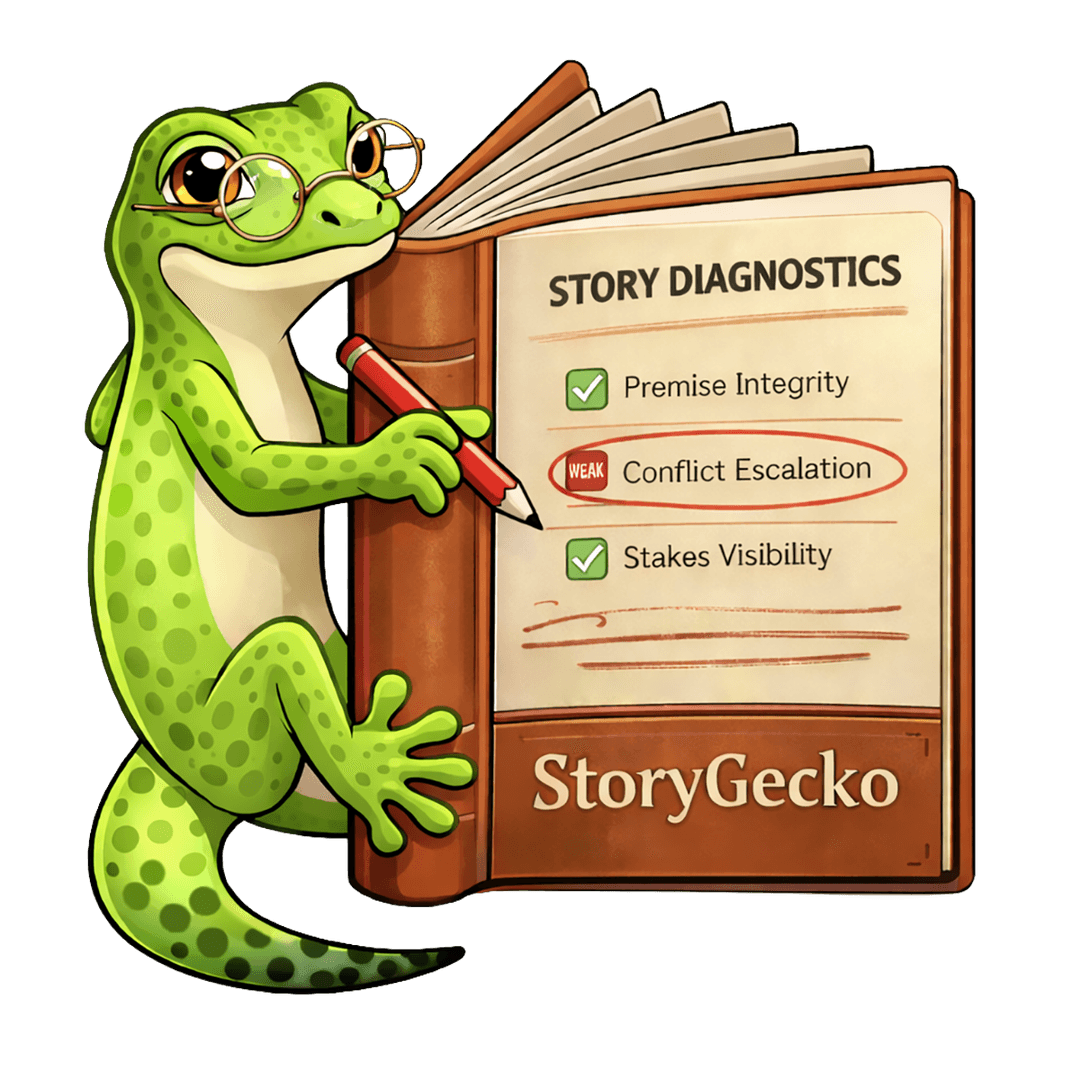
One tool. Comprehensive insight.
A diagnostic that tells you exactly what's wrong — chapter by chapter, issue by issue.
Find out what a professional reader would flag
Nine specialized agents check your chapter for tension, stakes, pacing, dialogue, voice, cause-and-effect logic, and more. A synthesis agent compiles every finding into one structured report with severity tiers and specific, actionable guidance grounded in your actual text.
- 9 diagnostic agents run in parallel
- Critical / High / Moderate / Polish severity tiers
- Grounded observations — no generic advice
- Genre-aware across 12 fiction categories
The rejection letter that tells you nothing
"Thank you for submitting your manuscript. Unfortunately, this project isn't quite right for my list at this time. I wish you the best of luck placing it elsewhere."
Strong characters. Compelling plot. Struggling on Amazon.
Self-published authors with genuinely good stories sometimes can't gain traction — not because readers don't exist, but because story structure shapes whether readers stay immersed, finish the book, and come back for the next one.
Structure drives reader immersion
Research on narrative transportation theory shows that readers become immersed — and stay immersed — when a story flows logically, events follow causally, and emotional stakes are clear. Structure is the engine beneath immersion.
Clarity keeps readers turning pages
Studies on readability and cognition show that poor structure creates friction — even when the prose is good. Readers who feel confused or unstuck quietly stop reading. Strong structure removes that friction.
Engagement leads to satisfaction
A 2024 study on narrative structure found it improves comprehension, increases motivation to keep reading, and enhances emotional impact. Readers who finish a book satisfied leave reviews. Readers who drift away don't.
The research is direct
Studies on structured storytelling systems show 10–50% improvements in story quality and measurable increases in reader engagement. StoryGecko applies the same structural principles — chapter by chapter, issue by issue.
The first chapter tells a literary agent everything
Within the first chapter, an experienced agent is reading for dozens of structural signals. Most writers know these rules exist. Almost none can hold all of them in their head while writing. StoryGecko holds them for you.
Nine agents. One comprehensive diagnostic.
StoryGecko runs nine specialized diagnostic agents in parallel — each focused on a different craft dimension — then synthesizes their findings into a single, actionable report.
Author submits a chapter
The writer pastes or uploads their chapter, selects their genre, and optionally notes any intentional choices they want StoryGecko to skip.
Nine agents run in parallel
Each agent is specialized: one reads for stakes, one for scene purpose, one for cause and effect, one for dialogue, one for theme. All nine run simultaneously in 15–30 seconds.
A synthesis agent compiles the report
A tenth agent reviews all nine findings and produces a structured diagnostic report: Critical issues, High Impact risks, Moderate observations, and Polish items — with specific, actionable guidance for each.
What a StoryGecko report looks like
Every report is specific to the chapter — not generic advice, but grounded observations tied to actual moments in the text. This is a real diagnostic run on Chapter 1 of The Hunger Games.
License StoryGecko for your platform
StoryGecko is built for platform licensing. Writing platforms, publishing tools, and literary communities can offer StoryGecko's diagnostic engine to their users — under their brand, on their infrastructure.
Genre-calibrated frameworks
12 genre frameworks — each one a proprietary diagnostic lens that calibrates agent behavior to the specific structural expectations of that genre and story position. No other tool does this.
White-label ready
The diagnostic engine runs on your API key. Your brand, your interface, your users — StoryGecko provides the IP: the agent architecture, the genre frameworks, and the synthesis logic.
Extensible platform architecture
The diagnostic engine is the foundation. The agent architecture and genre frameworks are designed to support additional tools and workflows as the platform grows.
Built for writers who take their craft seriously
Querying Authors
Writers preparing manuscripts for literary agent submission who need to know what a professional reader would flag — before the rejection arrives.
Self-Published Authors
Independent authors who want their books to perform on Amazon — and understand that structure is what separates immersive reads from books readers abandon at chapter three.
Writing Platform Users
Writers on platforms like Scrivener, NovelAI, or Reedsy who want professional-grade diagnostics built into their existing workflow — without switching tools.
Serious Craft Practitioners
Writers who've read the craft books, taken the workshops, and know the rules — but need an outside eye to tell them where their chapter is and isn't executing.

Let's talk about what StoryGecko can do for your platform.
We're currently exploring partnership opportunities with writing platforms, publishing tools, and literary communities. If your users are writers, we'd like to talk.
mark@storygecko.com→We respond to every inquiry personally.